Manufacturing group · via Delman Data Lab · 2022–2024
Procurement Master Data & Price Analytics
Data Scientist
Client engagement. Names, data, and identifying details are withheld; the architecture is described at a generalized level.
Problem
Each business unit kept its own item and supplier records, so the same bearing appeared as "B. 6311 ZZ", "BEARING ZZ 6311", and "bearing 6311 zzz", and one supplier showed up under several names and addresses. Nobody could see what the group really paid for an item or which supplier was cheapest.
Approach
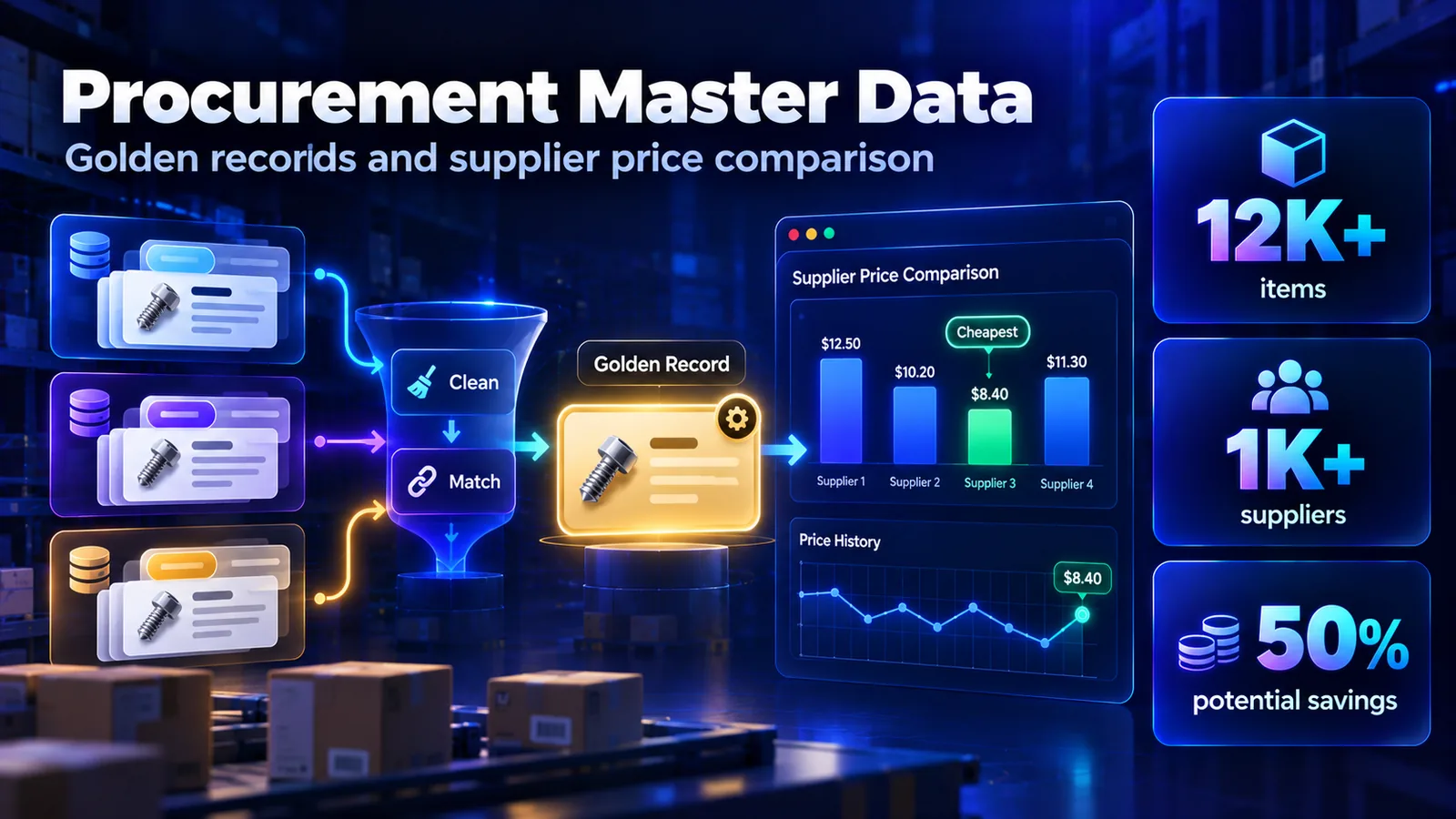
I built a master data pipeline on the client’s on-premise stack: combine raw data from all business units, keep active records and cluster items by type, clean and map fields, match similar records into one golden record per item, supplier, and transaction, then post-process and export to the corporate data warehouse. The golden records feed procurement analytics and a central price-comparison view.
Architecture
Hover a component to trace its connections · drag to pan · use + / − to zoom
- Source
- Processing
- Model
- Data store
- Output
How It Works
- CollectRaw item, supplier, and transaction data is synced from three business units.
- Union & filterSources are combined, only active records are kept, and items are clustered by type.
- Clean & mapNames, codes, and addresses are cleaned, formatted, and mapped to target fields.
- MatchSimilar records are matched into one golden record per item, supplier, and transaction.
- Export & analyzeGolden records go to the data warehouse and drive price variance, spending, ROI, and cross-supplier price comparison.
What I Built
- The cleaning and matching pipeline that turns variants like "B. 6311 ZZ" and "bearing 6311 zzz" into one master item, and supplier name and address variants into one master supplier.
- Golden records for items, suppliers, and transactions, exported to the corporate data warehouse.
- Procurement analytics: purchase price variance, total spending, procurement ROI, cross-supplier price search, and supplier price history.
Impact
The pipeline consolidates 12,000+ active items, 1,000+ active suppliers, and 46,000+ transactions in about 15 minutes from raw sync to export. Price discovery went from hours to minutes, and comparing suppliers revealed up to 50% potential savings.